Free deliveries for orders over £50
 info@agx-nordic.co.uk
 07709 389021


What counts as moisture?
Moisture is the presence of water in gaseous, solid or liquid form. It can occur through condensation, water ingress or direct spills.
Wherever it appears, from moisture in the basement and crawl spaces to moisture in the loft, it is important to recognise the signs early and take action.
What is a normal indoor humidity level?
Normal indoor humidity varies depending on climate and location. As a general guideline, an indoor humidity level between 30% and 50% is recommended to maintain a comfortable environment and avoid too much moisture that could lead to damp or mould problems.

How does moisture form?
Moisture forms when water evaporates from surfaces such as floors or walls, or when warm air meets colder surfaces and condenses. A common example is condensation forming on the outside of a cold drink on a warm day.
The same process can occur indoors on windows, walls and other cold surfaces.
What does 100% humidity mean?
100% humidity means that the air is holding the maximum amount of water vapour possible at a given temperature. When this limit is reached, excess moisture condenses into liquid water, which can result in fog, dew or visible condensation indoors.

What happens if there is too much moisture?
Excessive moisture can lead to a range of problems, especially indoors. It can cause moisture damage, mould growth, deterioration of building materials and unhealthy indoor conditions. Areas such as basements and lofts are particularly vulnerable, as they are often poorly ventilated.
Moisture damage can sometimes be identified by a musty or unpleasant smell, which is often an early warning sign that action is needed.
How do you remove moisture indoors?
To reduce moisture indoors, the following measures are often effective:
- Ventilation: Ensure good air circulation throughout the building.
- Use a dehumidifier: These devices actively remove moisture from the air and are especially useful in basements and other damp areas.
- Seal the building: Prevent moisture ingress by sealing basements, roofs and windows.
- Dry spills immediately: Standing water on floors or other surfaces can quickly lead to moisture problems.
Monitoring indoor conditions with hygrometers and moisture meters can help you identify problem areas early.

How do you fix moisture problems?
The correct solution depends on the cause of the moisture:
- In cases of moisture in the basement, check drainage around the building and ensure groundwater is directed away from the foundation.
- If moisture occurs in the loft, make sure the roof is in good condition and that the space is properly ventilated.
- If moisture problems are extensive or persistent, professional assessment and remediation may be necessary.
Understanding the cause is key to deciding moisture and then what? Whether simple improvements are enough or more comprehensive measures are required.
Can you measure moisture yourself?
Yes. Moisture can be monitored using moisture meters and hygrometers that allow you to measure humidity and temperature indoors.
These tools provide a simple and effective first step in identifying whether you have a moisture problem and where it is most severe.
Buy a hygrometer/moisture meter
View all our products-
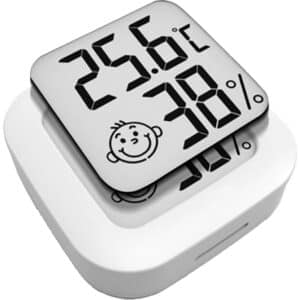
Mini moisture in the air meter
Super simple hygrometer in mini size. Displays both temperature and relative humidity. Includes a double-sided adhesive pad, so the moisture meter can be mounted on, for example, a cabinet door or a tile wall. Can also be placed on, for example, a shelf or a table.5.99 £ -
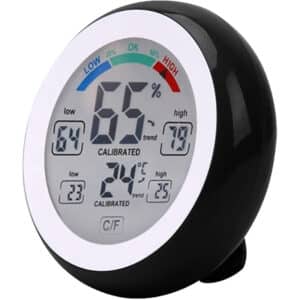
Measure humidity and temperature
Monitor relative humidity and temperature in your home or business with this simple hygrometer. Stylish design with a large, round screen. Can be hung on a wall or placed on a table. Relative humidity is measured in the range of 20-90% with an accuracy of ±5%. Temperature is measured in the range of 0-50 ℃ with an accuracy of ±1 ℃.12.99 £ -
Sale!
Sale!
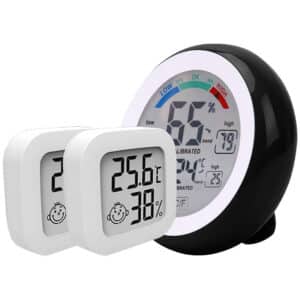
Humidity control pack
Monitor relative humidity and temperature in your home or business with this hygrometer pack. The pack contains 1 hygrometer with a large, round screen and two mini hygrometers, which can be placed on walls with stickers or via the magnet on the back on a fridge or freezer or stood on a table. Relative humidity is measured in the range of 20-90% with an accuracy of ±5%. Temperature is measured in the range of 0-50 ℃ with an accuracy of ±1 ℃.Original price was: 24.97 £.19.99 £Current price is: 19.99 £.