Free deliveries for orders over £50
 info@agx-nordic.co.uk
 07709 389021

Keep moisture out of your home
Black mould requires a damp environment to thrive. That’s why one of the most effective ways to prevent mould growth is to avoid too much moisture inside your home.
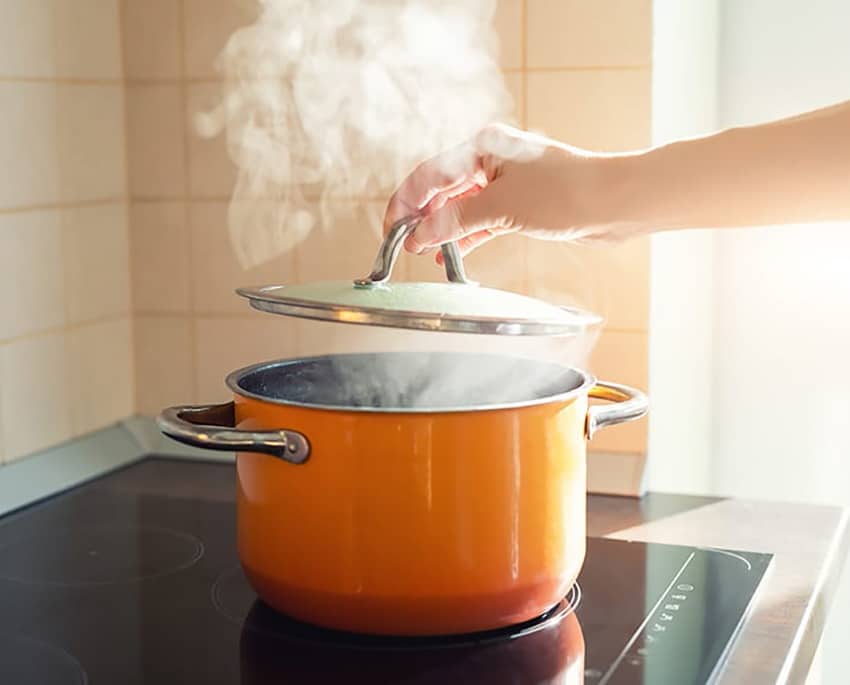
This is especially important during winter, when ventilation is often reduced. Everyday activities such as cooking, showering and drying clothes can quickly increase indoor humidity levels. In older properties, moisture problems are often more difficult to avoid, particularly moisture in the basement, where rising groundwater, poor sealing or outdated construction can allow damp to build up.
If relative humidity (humidity at a given temperature, RH) rises above 70%, black mould can begin to grow on almost all organic materials. When relative humidity exceeds 95%, or when surfaces are directly damp, even small amounts of organic material such as dust are enough for mould to spread to inorganic porous materials as well.
Under the right conditions, black mould can establish itself within a single week. Some mould types thrive already at around 70% relative humidity, while others require even higher moisture levels.
Not just warm air
The warmer the air, the more water vapour (moisture) the same volume of air can hold before it starts releasing moisture to its surroundings. This is known as absolute humidity, which describes the amount of water vapour measured in grams per cubic metre of air.
For every increase of eleven degrees in temperature, air can hold roughly twice as much water vapour. Air at 5°C can hold 6.8 grams of water per cubic metre, while air at 16°C can hold 13.6 g/m³. At 27°C, the capacity increases to 27.2 g/m³.
Relative humidity, which is measured using hygrometers and moisture meters, describes the actual amount of water vapour in the air divided by the maximum amount the air can hold at a given temperature.
If we assume the air contains 6.8 grams of water vapour per cubic metre, the relative humidity would be:
- At 5°C = 6.8 / 6.8 = 100%
- At 16°C = 6.8 / 13.6 = 50%
- At 27°C = 6.8 / 27.2 = 25%
How to monitor humidity levels
Relative humidity is measured on a scale from 0 to 100% and can be tracked using a hygrometer. A hygrometer combines a moisture sensor with a thermometer, allowing you to measure humidity and temperature at the same time.
It is generally recommended to keep indoor relative humidity below 45%. This helps reduce house dust mites and creates less favourable conditions for black mould. Maintaining lower humidity levels is therefore an effective way to protect both your health and your building. You can read more about practical ways to reduce humidity indoors in homes and other buildings.
Relative humidity below 45% is most common during winter, when indoor heating is in use. In summer, humidity levels can easily rise to 70% or higher if moisture is not actively managed.
The relative humidity in your home also affects daily comfort. Most people feel best when indoor humidity is kept between 35% and 60%.
There are many different types of hygrometers available, including electronic and mechanical models. Electronic devices are often preferred, as they are accurate, easy to read and well suited for everyday use when monitoring moisture in the air.
Buy a hygrometer/moisture meter
View all our products-
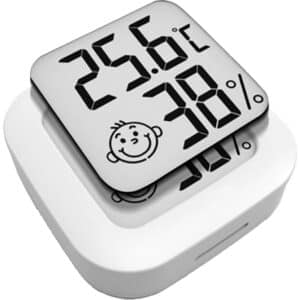
Mini moisture in the air meter
Super simple hygrometer in mini size. Displays both temperature and relative humidity. Includes a double-sided adhesive pad, so the moisture meter can be mounted on, for example, a cabinet door or a tile wall. Can also be placed on, for example, a shelf or a table.5.99 £ -
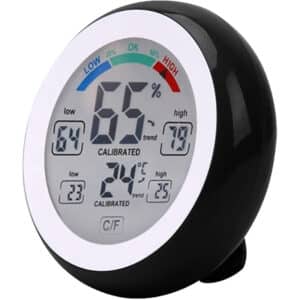
Measure humidity and temperature
Monitor relative humidity and temperature in your home or business with this simple hygrometer. Stylish design with a large, round screen. Can be hung on a wall or placed on a table. Relative humidity is measured in the range of 20-90% with an accuracy of ±5%. Temperature is measured in the range of 0-50 ℃ with an accuracy of ±1 ℃.12.99 £ -
Sale!
Sale!
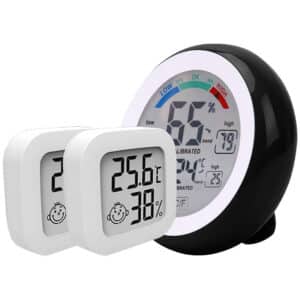
Humidity control pack
Monitor relative humidity and temperature in your home or business with this hygrometer pack. The pack contains 1 hygrometer with a large, round screen and two mini hygrometers, which can be placed on walls with stickers or via the magnet on the back on a fridge or freezer or stood on a table. Relative humidity is measured in the range of 20-90% with an accuracy of ±5%. Temperature is measured in the range of 0-50 ℃ with an accuracy of ±1 ℃.Original price was: 24.97 £.19.99 £Current price is: 19.99 £.