Free deliveries for orders over £50
 info@agx-nordic.co.uk
 07709 389021

Get a better indoor climate by avoiding too high humidity indoors
Make sure to keep exhaust ducts/fresh air vents open and clean. This ensures that fresh air is constantly coming in. This also applies to any basement rooms if you want to avoid moisture in the basement.
There should be fresh air vents/exhaust ducts in all rooms. This can, for example, be in the form of slot vents in newer windows. But a fresh air vent can also be a flap that is opened with a string, a so-called disc valve that is turned to adjust the amount of fresh air, or sliding valves.
Regardless of the type, fresh air vents can cause heat loss. A good alternative to the valves can therefore be humidity-controlled ventilation or a so-called heat recovery system, i.e. ventilation with heat recovery. Here, the heat energy is transferred from the air that is sucked out of the home to the fresh, cooler outside air that is blown into the home. This ensures constant ventilation, e.g. for ventilation of basements, with fresh air with only minimal heat loss.
Watch out for condensation
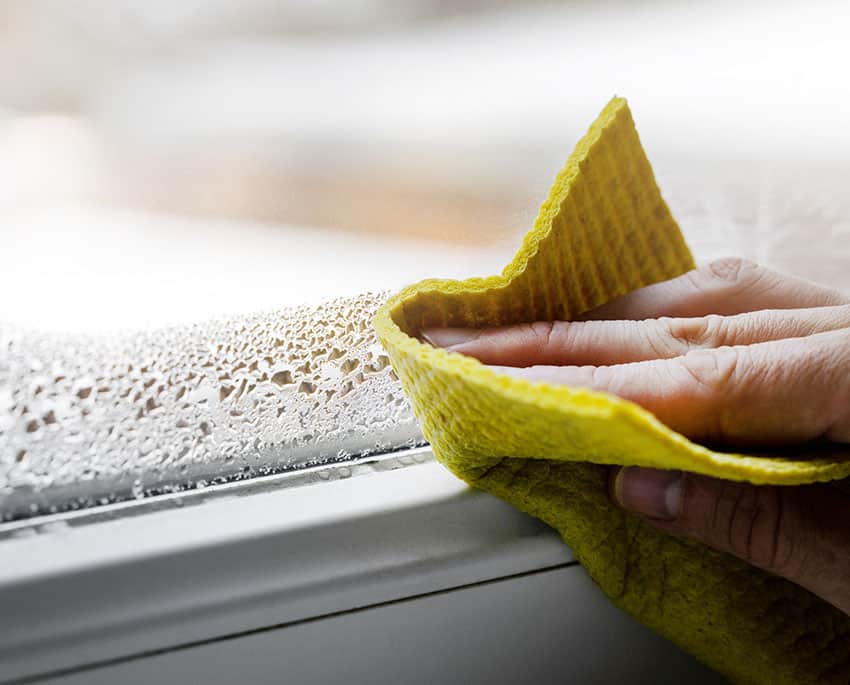
If condensation forms on the windows, wipe it off. The cloth you use for this should be hung outside to dry, as otherwise the damp cloth will simply release the moisture back into the indoor climate.
Condensation can occur when warm, moist air hits the cold surface of the window glass. When the air is then cooled by contact with the cold glass, it cannot hold nearly as much moisture as when it was heated. The excess moisture then settles on the window as condensation.
If this happens, the condensation can be wiped off with a cloth, so that there is no risk of mould forming or the windows being damaged by the moisture. However, we recommend that appropriate ventilation is established instead, e.g. in the form of mechanical ventilation, possibly with heat recovery, so that a permanent solution is found.
The worse the windows insulate (the colder the windows are on the inside), the greater the chance of condensation forming. Even with modern energy-efficient windows, condensation can occur if the humidity in the room becomes too high (warm air can hold much more moisture than cool air).
Incidentally, the coldest place in a window is at the frame at the bottom. This is also where the moisture will first condense.

Minimize steam from cooking
When cooking, the hood should be running. It is also a good idea to start it a little before and leave it running for some time afterwards. Also, check regularly that the hood’s intake and exhaust are working correctly.
It is also beneficial to have lids on pots that are boiling. The lid keeps the water vapor from escaping into the indoor air.
If you do not have a hood, you should ensure ventilation (for example, by opening the kitchen window ajar) while cooking. However, it is not nearly as effective as a hood.

Bathrooms and moisture
Close the bathroom door and turn on the extractor fan when taking a shower. After taking a shower, water from the floor and walls should be directed down the drain, e.g. with a mop.
This not only reduces the amount of moisture in the air, but also limits problems with limescale. It is also always a good idea to air out for 10-15 minutes with the door closed after taking a shower.
If you use a towel to dry the shower after taking a shower, for example, the towel should be hung outside to dry. Otherwise, the towel will simply release the moisture back into the indoor air.

Laundry releases moisture
Clothes that are hung to dry release their moisture into the air. If the wet clothes are hung indoors, the indoor air must remove this moisture. Laundry should therefore always be dried outdoors.
Alternatively, you can use a dryer. However, it must be a dryer with a condensation effect or vented to the outside.
If clothes are to be dried indoors, without using a dryer, there should be a humidity-controlled extraction system that automatically switches on if the humidity becomes too high. It is of course also an option to have a dehumidifier running while the clothes are drying.
In the summer months, you can of course just leave a window open to get rid of the moist air. In winter, however, this will cool the surfaces in the room so much that it can cause condensation and thus an increased risk of mould. In that case, it would be more obvious to install a recirculation system.
How to keep your home free of moisture
If you keep the indoor climate dry and ensure that there is good ventilation, you can limit the risk of mould and dust mites. You can keep the humidity in your home down by following these eight tips:
- Make sure to ventilate well: Ventilate the home for 5-10 minutes several times a day. You should be extra careful with the ventilation in the bathroom and in the kitchen when you have taken a shower or cooked.
- Always make sure to use the hood when cooking. Check that the extraction and exhaust are working properly. Also, make sure to have lids on pots that are boiling so that the water vapor does not escape into the indoor air.
- Interior doors should be kept open unless you are taking a shower or cooking. This gives the air a better chance to circulate in the home and thus lead away any moisture.
- Keep the bathroom door closed when you take a shower. Also make sure to turn on the ventilation or air out while you are in the shower so that the moisture can be removed again.
- Hang clothes to dry outside or use a dryer with a condensation effect or vent to the outside.
- Keep the same temperature in all rooms in the home. The temperature should not be lower than 18 degrees.
- Keep fresh air valves in window frames and walls open, and make sure that exhaust ducts and exhaust valves are working and clean. Alternatively, a good heat recovery system can ensure regular air exchange – even with almost no heat loss. Good ventilation can also help to avoid or reduce, for example, moisture in basement walls.
- If water damage occurs, you must ensure that the damage is repaired as soon as possible. Please contact us for help.
Buy a hygrometer/moisture meter
View all our products-
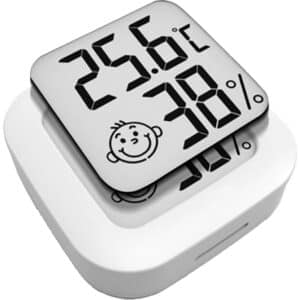
Mini moisture in the air meter
Super simple hygrometer in mini size. Displays both temperature and relative humidity. Includes a double-sided adhesive pad, so the moisture meter can be mounted on, for example, a cabinet door or a tile wall. Can also be placed on, for example, a shelf or a table.5.99 £ -
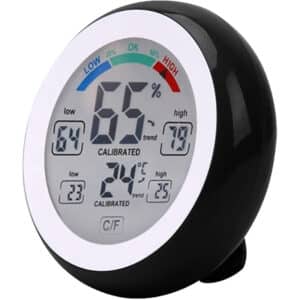
Measure humidity and temperature
Monitor relative humidity and temperature in your home or business with this simple hygrometer. Stylish design with a large, round screen. Can be hung on a wall or placed on a table. Relative humidity is measured in the range of 20-90% with an accuracy of ±5%. Temperature is measured in the range of 0-50 ℃ with an accuracy of ±1 ℃.12.99 £ -
Sale!
Sale!
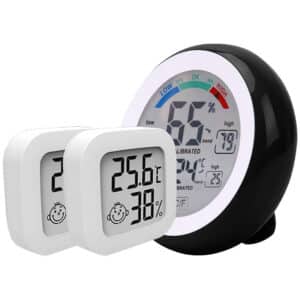
Humidity control pack
Monitor relative humidity and temperature in your home or business with this hygrometer pack. The pack contains 1 hygrometer with a large, round screen and two mini hygrometers, which can be placed on walls with stickers or via the magnet on the back on a fridge or freezer or stood on a table. Relative humidity is measured in the range of 20-90% with an accuracy of ±5%. Temperature is measured in the range of 0-50 ℃ with an accuracy of ±1 ℃.Original price was: 24.97 £.19.99 £Current price is: 19.99 £.