Free deliveries for orders over £50
 info@agx-nordic.co.uk
 07709 389021
Humidity is an important factor if you want a good indoor climate
Therefore, it is a really good idea to make sure that the humidity in your home or business does not get too high. If the relative humidity (RH) exceeds 70 percent, mould can germinate on almost any organic material.

Get control of the humidity
Relative humidity is measured on a scale from 0 to 100 percent and can be measured with a so-called hygrometer. A hygrometer contains both a specific humidity meter and a thermometer, which makes it possible to determine the relative humidity.
It is recommended that the relative humidity inside is kept below 45 percent. This will not only make it much more difficult for mould to germinate, but also help reduce the amount of house dust mites.
Outside the winter months, when there is no heating indoors, it can be difficult to keep the relative humidity below 45 percent. In the summer months, the relative humidity can thus reach close to 70 percent, unless you are careful and keep an eye on it.

Indoor climate
However, you should also make sure that the relative humidity does not become too low, as this can also affect the indoor climate and our well-being. We humans normally thrive best if the relative humidity is between 35 and 60 percent.
If you want to keep an eye on the relative humidity yourself, for example to avoid moisture in the basement, we recommend an electronic hygrometer. The electronic versions are, in relation to the price, quite accurate and easy to use. In our shop we offer a wide selection at reasonable prices. Here you can also buy professional moisture meters that allow you to measure the moisture in materials.
Too much moisture can cause mould and dust mites
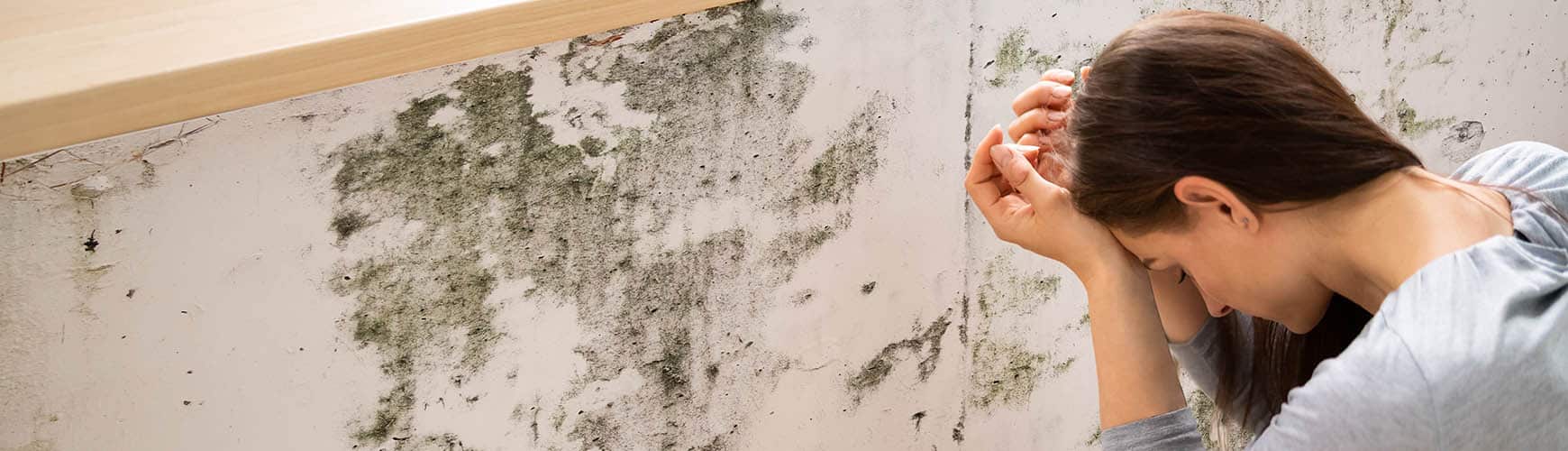
Mould, if visible, is not only unsightly to look at and, in some cases, also smelly. It can also be extremely harmful to your and your family’s health.
Mould emits spores and other microparticles, and can thus cause allergy-like conditions, such as a runny nose, sore throat, sneezing, coughing and headaches. In the worst case, it can even cause damage to internal organs such as the brain and kidneys. In some people, skin irritations can also be a symptom of mould.

More than just hot air
The warmer the air, the more water vapour (moisture) the same amount of air can hold before the moisture is released into the environment. This is called absolute humidity and indicates the amount of water vapour as grams of water per cubic meter of air (g/m³).
A rule of thumb is that for every 11 °C increase in temperature, the air can hold twice as much water vapour. For example, air at a temperature of 5 °C can hold 6.8 grams of water vapour per cubic meter of air. If the temperature rises to 16 °C, the same air can hold 13.6 grams of water vapour per cubic meter.
Relative humidity, which is measured with a so-called hygrometer, refers to the actual amount of water vapour in the air, divided by the amount of water vapour the air can hold at a given temperature. In other words, this means that if a cubic meter of air that is 16 °C warm contains 6.8 grams of water vapor, the relative humidity is 50 percent (6.8/13.6).
Test it yourself
If you have or have had challenges with moisture, it can be a really good idea to test for mould. For example, with a surface test such as the easy and simple PRO-Clean test, where you can determine in a very short time whether there is mould on a wall or the like. Or with an air test, where the air content is examined for germinating mould spores.
With an air test, you let the spores in the air fall over a special gel (cultivation medium) in a petri dish for an hour. After that, the mould colonies can grow over a few days, and the result can be assessed. Or the variant where you send the test dish to our laboratory for a thorough analysis of both the extent and types of mould.
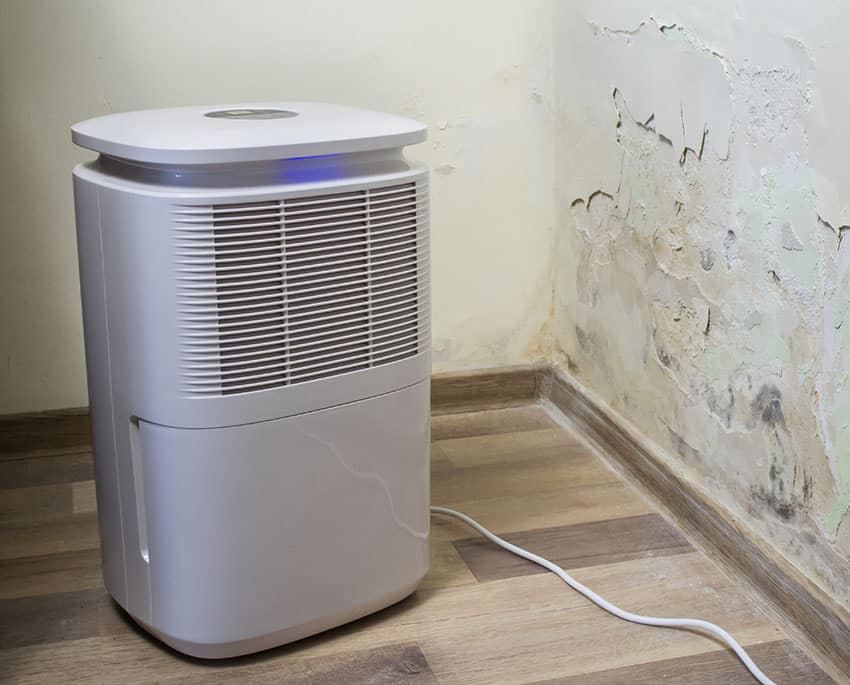
If the damage has occurred
For example, if you have had water damage in your home or if there is simply too much moisture in the basement, more than ventilation, airing and extra heating may be necessary. In this case, actual dehumidification, with a so-called dehumidifier, may be necessary.
A dehumidifier is a device that can draw moisture out of the surrounding air and then separate the moisture as water into a container or a drain. Technically, the most common dehumidifiers (so-called condenser dehumidifiers) work by sucking the moist air into the device, where the air is then cooled to the dew point, so that the air’s water vapor content (moisture) condenses into water.
When you dehumidify after water damage or dehumidify a basement, you should make sure to keep doors and windows closed. Otherwise, you risk simply drawing even more moisture from the outside air into the indoor climate.
You should also keep the temperature high, as condenser dehumidifiers in particular work best at higher temperatures. Typically, the temperature must be at least 15 °C for them to function optimally.
It is also a good idea to have one or more fans running to ensure good air circulation in the room. Often the motor that sucks air into the dehumidifier is not very powerful and will therefore only “capture” the air right around the device.
Dehumidification can take time, typically several weeks, so be patient. But also make sure not to dehumidify for longer than necessary. The humidity in the floors and walls must not fall below 12-15%, otherwise you risk new damage from drying out!
Buy a hygrometer/moisture meter
View all our products-
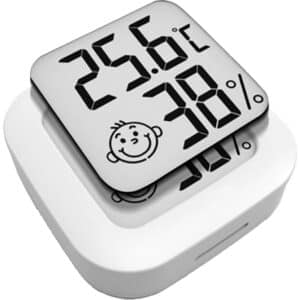
Mini moisture in the air meter
Super simple hygrometer in mini size. Displays both temperature and relative humidity. Includes a double-sided adhesive pad, so the moisture meter can be mounted on, for example, a cabinet door or a tile wall. Can also be placed on, for example, a shelf or a table.5.99 £ -
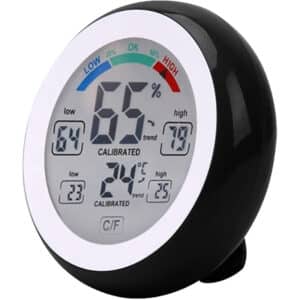
Measure humidity and temperature
Monitor relative humidity and temperature in your home or business with this simple hygrometer. Stylish design with a large, round screen. Can be hung on a wall or placed on a table. Relative humidity is measured in the range of 20-90% with an accuracy of ±5%. Temperature is measured in the range of 0-50 ℃ with an accuracy of ±1 ℃.12.99 £ -
Sale!
Sale!
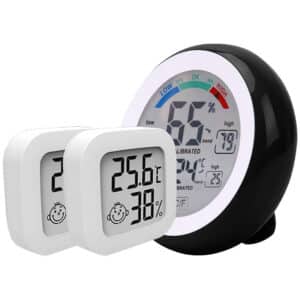
Humidity control pack
Monitor relative humidity and temperature in your home or business with this hygrometer pack. The pack contains 1 hygrometer with a large, round screen and two mini hygrometers, which can be placed on walls with stickers or via the magnet on the back on a fridge or freezer or stood on a table. Relative humidity is measured in the range of 20-90% with an accuracy of ±5%. Temperature is measured in the range of 0-50 ℃ with an accuracy of ±1 ℃.Original price was: 24.97 £.19.99 £Current price is: 19.99 £.